Glovo is building a €1.5 billion advertising business on a foundation that may not hold
e-com
Barcelona
Strategy
A strategic analysis from of the tension between Glovo's AdTech ambition and its partner activation reality. Told through their own sales materials, job listings and investor reports.
Glovo wants you to think of it as a tech company. They say so explicitly in their own LinkedIn posts: "We're a tech company, not a delivery company." That framing is fair. What is less clear however, is whether the commercial operation supporting that ambition is keeping pace with it. The relevant signals are not hidden but are spread across Glovo’s own published materials.
I've spent several weeks going through Glovo's own sales materials, their active job listings in Barcelona, Delivery Hero's investor reports for Q2, Q3 and Q4 2025, and their published tutorial resources for partners. The picture that emerges is of a company with a genuinely strong product ánd at the same time a clear commercial tension.
Keep in mind, this is not a hit piece. Glovo has built something real and their partner infrastructure is more developed than most outsiders appreciate. But there is a structural gap between their AdTech ambition and their partner activation operation. The numbers, the job listings and their own sales materials all point in the same direction.
That combination is too consistent to ignore.
First, the crown jewel
Glovo's AdTech business is the most important strategic development in their story right now, and it is not getting the external attention it deserves. According to Delivery Hero's Q4 2025 trading update, AdTech revenue has reached €1.5 billion growing at a 50% compound annual growth rate. They offer sponsored listings, homepage bubbles, keyword ads and deal personalisation. This is no longer an adjacent revenue stream and is likely becoming the primary driver of future margin.
The commercial logic is obvious once you see it. Glovo operates one of the highest-intent digital surfaces in Southern Europe. When someone opens the app, they are not browsing. They are about to spend money. That moment is valuable because it allows Glovo to influence which business gets the order among its 150,000+ partners.
Their own LinkedIn content makes the pitch concrete. They showcase Krispy Kreme using Partner Ads to launch in Morocco, with sponsored listings and homepage bubbles driving immediate sales across five stores. The target return on advertising spend across their products is 5x or greater. This is a genuinely powerful business model. But it has a dependency that Glovo's public narrative consistently underplays.
The dependency Glovo's own materials make explicit
Here is what makes this analysis grounded rather than speculative: Glovo themselves have already described the dependency in their own partner sales materials, without fully addressing its implications.
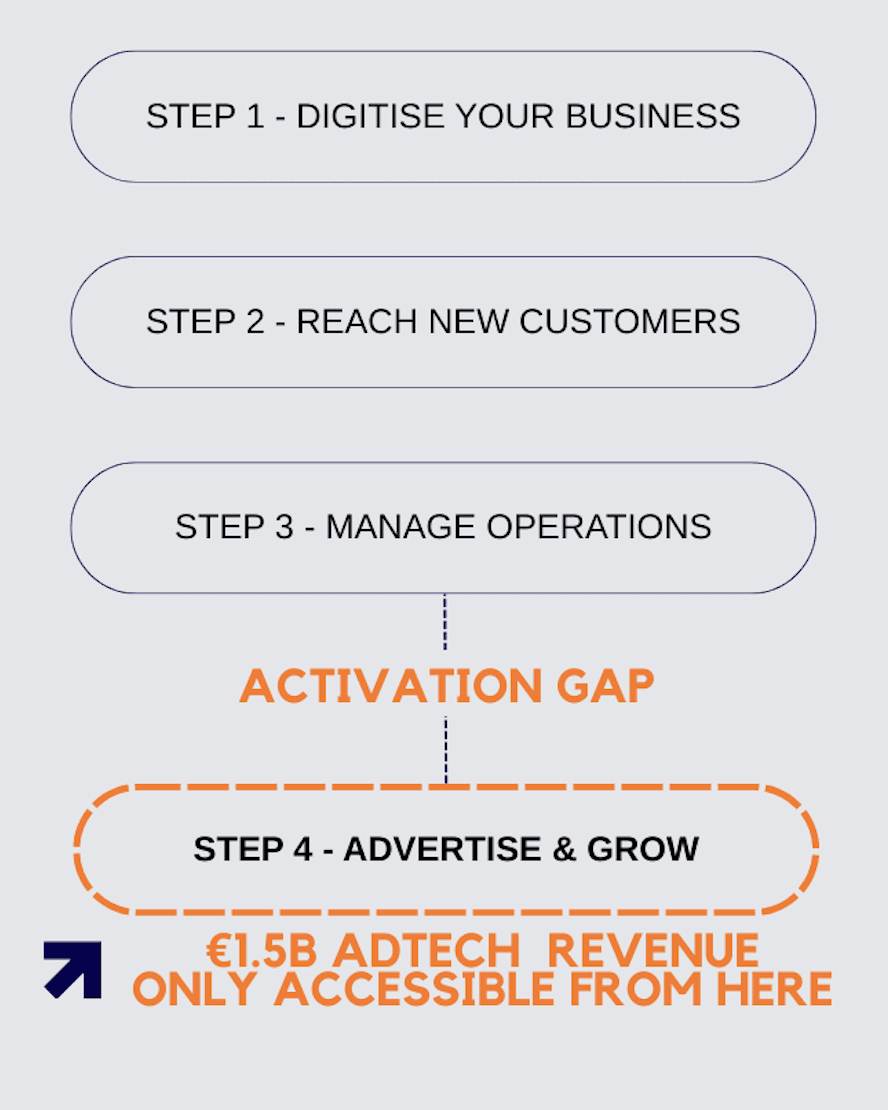
Their partner onboarding journey moves through digitisation, customer reach, operational management and only thén to promotions and advertising.
Step 1: bring your offline business online.
Step 2: reach new customers instantly.
Step 3: manage operations through the app.
Step 4: use promotions and ads to grow demand.
That sequence is the entire argument. Step 4 (the €1.5 billion revenue line) only works if Steps 1, 2, and 3 work first. A partner who has not successfully activated is unlikely to invest in advertising. This usually means they lack reliable order flow or do not yet trust the platform operationally. This is especially true for smaller and mid-sized partners, not because they are being difficult, but because the investment does not make rational sense until the foundation is solid.
This is not my inference. This is Glovo's own commercial architecture, described in their own words. AdTech revenue is structurally downstream of partner activation. Every partner who stalls at Steps 1 through 3 is unlikely to reach Step 4. And therefore represents an advertising customer Glovo may never have.
The question that follows is: how well is Glovo actually managing Steps 1 through 3?
What the partner portal reveals and conceals
The honest answer starts with a genuine acknowledgement. Glovo's partner portal and tutorial resources are more developed than most people outside the company realise. Partners have a self-service promotions tool, a performance dashboard, a Manager Portal for tracking campaigns, and structured tutorial content covering order management, store operations, and menu optimisation. These are useful sources for a partner who arrives digitally confident and commercially motivated.
There is also a deliberate activation mechanism built into the ranking algorithm. Glovo's published materials state explicitly that new partners appear first in the app regardless of their performance record; a designed boost to help them generate early orders and build initial momentum. That is a genuine attempt to solve the cold-start problem.
But that same mechanism carries an underappreciated risk. The artificial visibility boost distorts the early experience. What partners see in the first days is not representative of long-term organic performance. When the boost fades, visibility drops. Partners who were not guided toward strong operational fundamentals feel this drop immediately. That is precisely the moment a partner will lose confidence in the platform. And a partner who loses confidence does not move to Step 4. The boost can mask the activation problem rather than solve it.
The tutorial architecture reinforces the same concern from a different angle. The learning content is structured as: First Steps, Manage Orders, Manage Your Store, Improve Your Menu. And only then, last, Boost Your Restaurant. Advertising sits at the end of the educational hierarchy, not woven throughout it. For partners who stall during activation, the advertising products Glovo is counting on for growth may as well not exist.
A well-built self-service portal supports partners who are already succeeding and does not replace human accountability during the activation window. That window determines whether a partner ever reaches the point of investing in growth.
Three job listings. One question that won't go away.
Which brings us to the job listings..
I found 3 separate senior roles among Glovo's active Barcelona postings that have nearly identical job descriptions. A Senior Sales Operations Analyst, a Senior Project Manager, and a Senior Business Analyst Sales & Automation. Each one owns, and I quoting directly from the listings: "Partner Performance in the first 30 days, ensuring that thousands of newly onboarded partners successfully activate, reach their first orders quickly, and achieve operational excellence from day one."
Same mission. Same KPIs. Same 30-day brief. Three different senior roles.
The comfortable interpretation is that these roles serve different partner categories (such as restaurants, grocers, retailers), or different geographies or lifecycle segments, in which case the parallel structure is intentional. That is possible and I cannot rule it out.
But the less comfortable interpretation is more familiar to anyone who has managed commercial operations at scale. n my experience, this pattern signals unclear ownership. When multiple senior roles share the same brief over the same time window, accountability tends to blur. Accountability that lives in three places simultaneously tends to live in none of them.
The portal is functional. The tutorials exist. The boost mechanism is real. None of that answers the question of who is accountable when a specific partner is struggling in week two of their activation and the visibility drop is coming. The job listings leave that question unanswered.
Then the financials added a contradiction
Delivery Hero's Half-Year Financial Report 2025 contains one line that sits uncomfortably alongside everything above. Headcount increased due to delivery personnel and product development but was "partially offset by reductions in sales activities and business support functions."
Precision matters here. The report covers Delivery Hero's entire global operation and does not specify which sales functions were reduced, in which markets, or at what level. We cannot conclude from this line alone that partner-facing roles in Europe were cut. "Sales activities" in a business of this complexity could mean many things.
What we can say is this: Glovo is simultaneously hiring three senior roles with identical activation briefs and reducing headcount in sales and support functions. Those two facts point in opposite directions. One suggests the activation process needs more resource. The other suggests the organisation is moving resource away from commercial relationship functions. That tension deserves to be resolved explicitly, not left to chance.
The European financial context adds pressure rather than excuse. Europe (primarily Glovo) carries a negative EBITDA margin. This is largely due to the court-mandated transition to an employment-based rider model in Spain. That is a specific regulatory cost and not evidence of GTM failure. But it does mean Glovo is managing significant financial constraint in their home region at the exact moment they are trying to scale a partner advertising business that depends on partner confidence and commercial investment.
The pressure to cut costs in that environment is understandable. The strategic risk is that the cuts land in the places that feed the revenue line they are most counting on to grow.
What Glovo should actually do
One structural shift and three concrete moves.
The structural shift: treat partner activation as the first chapter of an advertising relationship, not as an operational milestone to clear before the real work begins. The four-step partner journey Glovo already publishes contains the right logic. The gap is that this logic does not yet appear to be driving how the activation function is organised, resourced, or measured in a consistent way.
Consolidate activation ownership. Whether the three overlapping senior roles reflect intentional market segmentation or genuine accountability diffusion, the first 30 days of a partner's life on the platform needs one function with unambiguous responsibility. It also needs KPIs that connect early activation quality to long-term partner value, including eventual advertising spend. Measuring time to first order is necessary but not sufficient. A stronger metric would be time to first advertising investment.
Move the advertising narrative earlier. Glovo's own case studies (Krispy Kreme, the 5x ROAS target, the growth tools) are currently used in partner acquisition and marketing. They should be embedded into the onboarding experience from day one. A partner who understands from the start that Step 4 exists, and what it delivers, will activate with a fundamentally different commercial mindset than one who discovers advertising as an optional extra months later. The proof points already exist, they are simply introduced too late in the journey.
Protect the humans in the activation window. The self-service portal is well-built and genuinely useful for partners who are already succeeding. It does not substitute for human accountability when a specific partner is struggling before the visibility boost fades and the confidence drop sets in. Whatever the headcount changes have touched, the commercial roles that sit between a new partner and their first advertising investment deserve to be treated as revenue-generating functions, not as overhead to optimise away.
The bottom line
Glovo has built one of the most commercially interesting platforms in European tech. The Q-Commerce vision is real. The AdTech business is real. The product works. Users feel it every day, even when they don't have the language to describe it accurately.
The signals visible from the outside (three overlapping activation roles, a tutorial hierarchy that positions advertising at the end, a ranking boost that may mask rather than solve the cold-start problem, financial pressure on commercial headcount) are each individually explainable. Together they describe something more significant: a company whose AdTech growth story depends on a partner activation funnel that does not yet appear to be optimised for that outcome.
Glovo's own four-step partner journey states the dependency clearly. You cannot reliably reach Step 4 without Steps 1, 2, and 3 working well. A €1.5 billion advertising business requires a healthy, confident, well-activated partner base underneath it.
That gap between the advertising ambition at the top of the funnel and the activation reality underneath it is entirely fixable. But only if it is named first.
Sources
Delivery Hero Q4 2025 Trading Update (February 2026) · Delivery Hero Half-Year Financial Report H1 2025 · Glovo Partner Acquisition Portal - Spain (part-acq-stage.glovoint.com) · Glovo Partner Tutorial Resources - Boost Your Restaurant section · Glovo Partner Onboarding Guide (image.partner.glovoapp.com) · Glovo LinkedIn posts February-March 2026 · TechEstate - Glovo advertising options for partners (August 2023) · Glovo Barcelona job listings, active March 2026. All interpretations are my own and subject to the limitations of external analysis.